
Chiropractic Care
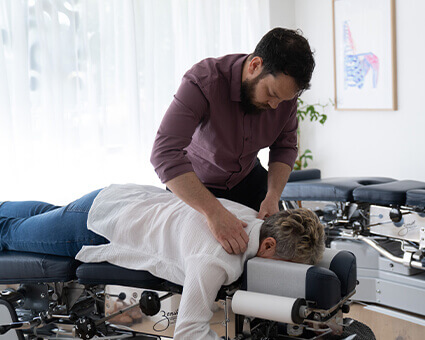 If headaches and migraines, sciatica, shoulder pain, knee pain, or low back pain are slowing you down, you’re in the right place. At Chiropractic Family Care, we deliver friendly, family-centered care with a premium feel and a clear plan so you always know what’s happening and why. Many people are surprised how much better life feels when the brain and body communicate well again.
These are five of the most common concerns we help with every week: Headaches & migraines, Sciatica, Shoulder pain, Knee pain, and Low back pain. Our approach suits busy families who want lasting results, not just a quick fix.
How Chiropractic Works (and Why We Focus on Your Nervous System)
As our dedicated Chiropractors explains at your first visit, your spine is like a suit of armor for your nervous system. When joints stop moving well, they can irritate nearby nerves and muddy the signals between your brain and body. Gentle chiropractic adjustments aim to reduce that interference so your brain can better regulate function and support recovery over time. We use Insight CoreScore scanning to measure nerve function and track progress. On-site digital X-ray facilities to streamline assessments and reduce delays.

Techniques and Tools Tailored to You
Care is customised to your body and your preferences. We use Diversified adjustments (precise, hands-on corrections to restore normal joint motion) and Thompson drop technique (table drop pieces that allow a gentle, targeted adjustment). Low-force options include Activator Methods® (a spring-loaded tool for precise corrections) and Accustim (an electronic impulse device that helps reduce muscle guarding and improve motion). We also offer a Y-strap option in select cases and adjust extremities like shoulders, elbows, wrists, hips, knees, and ankles. Our top-of-the-line Zenith tables help keep visits comfortable and efficient. If you prefer a certain style of adjusting, please ask.
Frequently Asked Questions
What is chiropractic?
What does chiropractic do?
- Reduce pain and stiffness
- Improve posture and mobility
- Support nervous system function
- Enhance your body’s ability to adapt to stress (physical, emotional, and chemical)
- Promote long-term health and resilience
Chiropractic Family Care’s approach is always personalised, gentle, and focused on what’s most appropriate for your body, lifestyle, and goals.
So how come I don’t always feel symptoms and pain?
Will I be adjusted on my first visit?
So why won’t I always feel good after an adjustment?
How do we get subluxations?
- Physical stress – poor posture, falls, injuries, repetitive movements, sleeping awkwardly, or even birth trauma. Many subluxations actually start in childhood from everyday bumps and falls.
- Chemical stress – poor diet, processed foods, toxins, air impurities, medications, and dehydration can all create tension and inflammation that affects your spine.
- Emotional stress – work pressure, relationship challenges, and daily worries create physical tension in your body. Think about how your shoulders tighten or jaw clenches when you’re stressed—this tension can lead to subluxations.
The reality is we all experience these stresses regularly in modern life. That’s why regular chiropractic care helps address them before they accumulate into bigger problems. At Chiropractic Family Care, I’ll help identify what’s affecting your spine and create a personalized plan to keep you functioning at your best.
What is an adjustment?
What is the IQ Impulse adjusting instrument?
Some of the unique benefits of the Impulse iQ include:
- Extreme speed:The iQ is twice as fast as other adjusting instruments and 100x faster than manual chiropractic adjustments. The gentle thrust is faster than the body’s tendency to tighten up & resist the adjustment.’
- Controlled Force: It has 3 different force settings for different parts of the body & to treat patients of all ages. The controlled low force thrust of the iQ make treatments comfortable.’
- Computerized Adjustment: High-tech computerized adjustments with the iQ precisely measure how the spine is moving during the treatment so that just the right amount of care can be provided.’
- Research: Years of research have gone into the development of the Impulse iQ Adjusting Instrument to create gentle & specific chiropractic adjustments that are safe & effective for patients of all ages.’
How does Arthrostim® adjusting work?
An Arthrostim® adjustment involves the use of one of these special instruments. It has an appearance similar to a drill, and is held in a similar manner. What it does is produce a speedy thrust and recoil motion, similar to the way a chiropractor uses their hands to adjust the vertebrae in your back. The benefit of the instrument is that it performs this high-velocity, low-amplitude motion 12 times per second, and is targeted to a very small area. The force of the thrust radiates through the joint and the tissues that surround it, releasing trigger points that are often the cause of muscle spasms.
As opposed to traditional chiropractic adjustment techniques, use of the Arthrostim® does not cause the same popping and cracking noises in the joint that can make some people feel uneasy. It is a gentle, mechanical method of easing the joints back into alignment that is basically an extension of the chiropractor’s hands. Your chiropractor can exert just the right amount of pressure needed by adjusting the force of the thrust up or down from merely a few ounces all the way up to 40 pounds, and it works on a wide range of body areas, not only on the spine.
Several studies have shown that instrument adjusting is just as effective as traditional chiropractic techniques for easing pain and increasing range of motion in patients who have sought chiropractic care. Its speed, gentleness and accuracy are also recommended for populations that may have trouble with the use of traditional chiropractic techniques, such as children and the elderly.
The Arthrostim’s® movement stimulates the patient’s special sensory nerve receptors, called proprioceptors, which are responsible for detecting the proper motion and alignment of the body’s muscles and joints, signaling that all is well; however, at the same time it avoids stimulating the nociceptors, the sensory nerve receptors responsible for sending pain signals to the central nervous system.
The use of instrument adjusting, such as with the Arthrostim®, allows for fewer side-effects and less post-treatment muscle soreness. If this seems like a form of treatment you may be interested in, consult with your chiropractor and ask if it may be possible to incorporate Arthrostim® adjusting into your treatment regime.
I’ve been told that chiropractic affects the health of the whole body, not just my back and neck. How does that work?
When the spine is not in its correct alignment the movement in that area is abnormal, the nerves that exit at that point may not function at 100%. So the messages going out from the brain to the rest of the body and back to the brain may be incomplete or unclear.
This in turn will affect the way the body is able to organise, heal and operate. As an example, neck subluxations in children may cause concentration and learning problems, reoccurring ear infections, reoccurring tonsillitis, depressed immune system and an inability to thrive. Another example is an upper back (thoracic) subluxation that may cause you to have poor sleep and be grumpy to those around you.
So, if a subluxation in the spine directly affects the organs and tissues that those specific nerves lead to in the body, the opposite is also true. When a subluxation is corrected in the spine, this gives the body the optimum chance to self heal as the brain is free to communicate with those specific organs and tissues, directing exactly what is needed for optimum healing and function.
Many of our clients not only report feeling better in their necks and backs through chiropractic care, but they notice an improvement in their:
- immune system
- their ability to concentrate
- their mood
- their digestion
- their energy levels
- their ability to deal with stress
- their quality of sleep and much more.
When in acute pain should I use ice packs or heat packs?
Ice is used when the client is in acute and chronic pain and there is inflammation in the area concerned. An ice pack should be placed on the area for 5 – 10 minutes and then left off for 20 minutes. This should be repeated for 4 or 5 times in one sitting and then repeated later in the day/night as needed. Ice packs should never be used on the very top of the neck where it joins to the head (an iced towel should be used instead).
Heat packs are used when there is aching or general soreness in the areas of the spine and neck. A heat pack should be placed on the affected area for 10 – 15 minutes and then left off for 30 minutes. This should be repeated 4 or 5 times in one sitting and then repeated later in the day/night as needed.
Do I need to get undressed for my treatments?
Schedule Your Appointment
Ready for clear answers and a plan that fits real life? Book your initial visit today, and ask about the complimentary family check-up when you begin care.
CONTACT US
